
Take Risks, Work Smarter, and Push For a Universal Basic Income
Excerpt from "Beyond Elon: The Next Great EV and Living Past 200"

Change is happening and it’s wild. Each day shifts in culture, politics, climate, and technology unfold at an increasing rate.
Many write and speculate on what’s to come. Certainly you have read (or grazed) countless articles on artificial intelligence, the rise of political oppression, environmental catastrophe, and other worrying factors of reality.
There are a lot of opinions out there about how “bad” it’s going to get.
What we see less often are positive visions of the future—speculations of how good it could get.
It’s understandable that we fixate on the negative. Not only does the news media enforce this at every corner, many of us don’t feel safe and secure enough to not worry. Maybe our bills (with the rising cost of rent and food) are higher than our income or maybe our gender identity is outside of traditional norms or maybe we live in an area that is affected by fires or floods.
It’s easy to get lost in overwhelm, fear, and the endless information about what’s happening on the planet. But that doesn’t mean we give into it.
The time has come for innovation. Bold innovation that meets the times.
We can’t let ourselves be overcome by anxiety of the unknown. It doesn’t matter how much writing is on the wall. We all have pens in our hands. We can write a future we want to live in.
Someone who is excellent at bending the arc of the future towards his will is my friend Jerry Kroll. I met Jerry in 2020 when I ran for Member of the Legislative Assembly with the BC Greens. He’d run for MLA in the same riding during the previous election and reached out to offer his congratulations on stepping into the role.
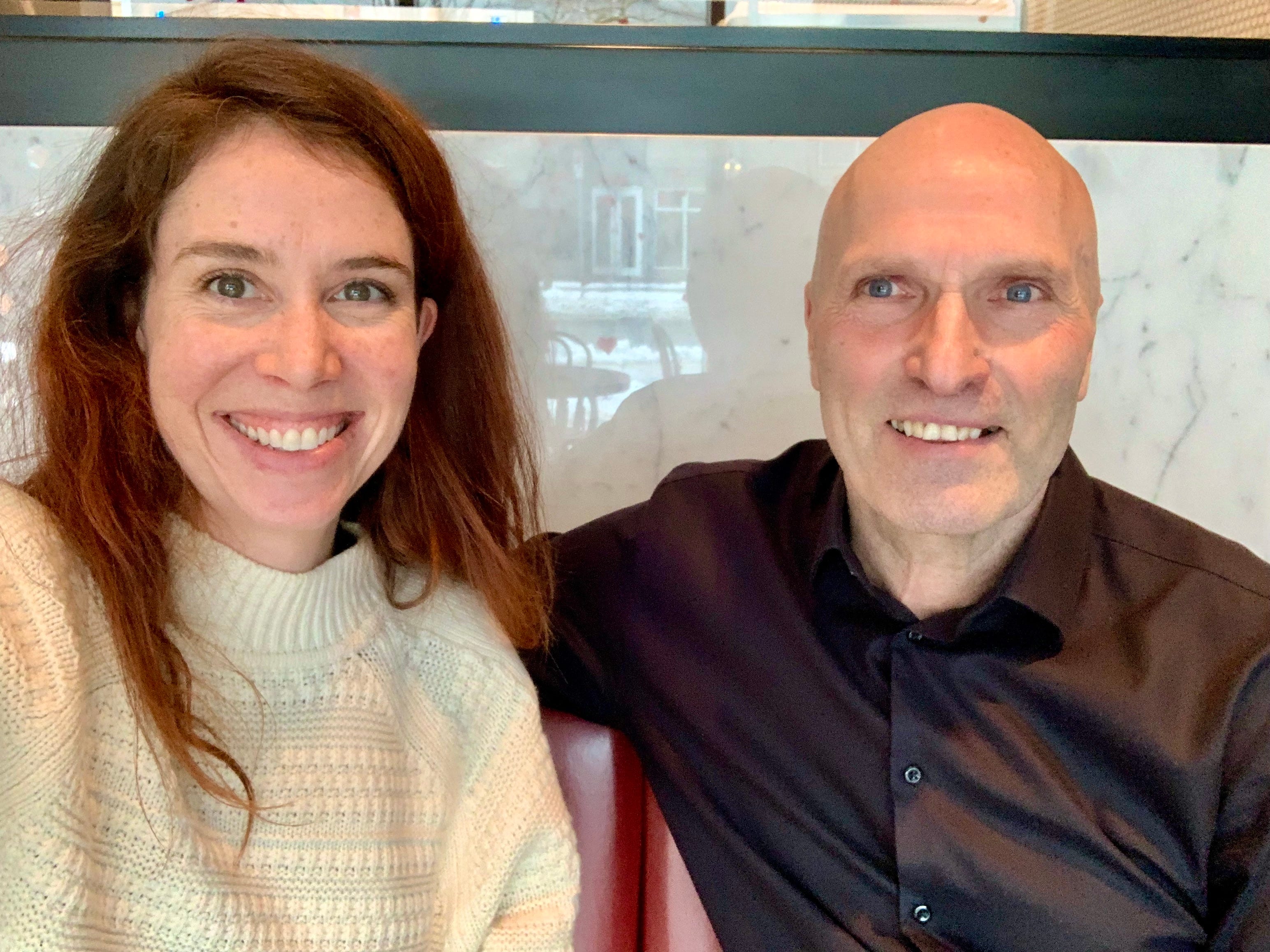
A few months after the election he reached out again, this time asking if I’d be interested in ghostwriting his book.
The pitch was simple. As an entrepreneur, Jerry had launched many successful companies. But this one was different: Human longevity.
Nay, human immortality.
He needed a book to get people on board with a concept much wilder and more difficult to embrace than electric cars or clothing made from hemp (two of his previous ventures that faced ideological pushback).
Immortality is the goal, he told me. But not the point. The point is longevity—thriving longer and enjoying being healthy in our bodies while we’re here.
His vision excited me and I agreed to write the book.
Which turned out to be an incredible and rewarding challenge. The act of telling someone else’s story stretched me in ways I couldn’t have imagined. Channeling Jerry’s worldview taught me so much about the world and how it works.
And even though Jerry and I have differing views on many things (my feelings about immortality are complicated, for starters), we agree on the important things. We both believe that all human beings deserve dignified housing, good food, clean air and water, and to live long, healthy lives pursuing their passions.
Without digressing too much from the point—because I am excited to share this excerpt with you—I think the biggest problem we have on the so-called “left” is in-fighting.
It’s time to give up the idea that we’re going to agree on everything and embrace the beauty of differing worldviews and opinions.
I don’t know everything there is to know—far from it. I’ve learned a lot of grace from Jerry, and working with him has softened the hard edges of my certainty.
There’s always more to learn. There’s always room to grow.
This is one of the best arguments for extending human life. History tends to repeat itself. But does it have to?
Often people fixate on what would happen if “bad” people lived longer, but I think that’s a narrow point of view. What would happen if we all lived longer?
I, for one, would love to turn to my elders who have passed onto the other side. Think about the wisdom that is lost every day. Think about how the world could be if those who had succumbed to age were still innovating and creating.
Regardless of your opinions around longevity (I know hearing about immorality can be triggering), the directive for those of us who have our health and our wits is clear.
We must focus our energy on innovation—on bringing a better world into being—instead of arguing with each other and getting lost in the grief and fear of what’s presently being done to the world.
Change is happening. Whether we like it or not, change is inevitable.
What is in our hands is the movement of that change.
Let’s work together to bend the arc of the future towards a world of possibility.
As Jerry always reminds me: Impossible also means “I’m possible.”
Indeed. Full speed ahead.
Excerpt from the “People, Planet, Profit” chapter in Beyond Elon: The Next Great EV and Living Past 200 by Jerry Kroll with Kelly Tatham
I know money is difficult to talk about because so many people struggle with it. For the most part, we can’t survive without it. That’s why I advocate for a universal basic income. The government has to recognize that you can’t have people out starving in the streets, that the infrastructure of a society is only as good as the weakest link in the chain. I know that every capitalist understands what that means. A universal basic income would strengthen the economy in the long run.
We have so many things backwards. We’re paying police to sweep the streets and “deal” with crime instead of paying to get people into houses and into mental health programs. When we fund policing and punishment-based services, it keeps perpetuating the problem, but if we funded solution-based services, it would solve the problem. By addressing issues at their roots, we create an ecosystem that allows society to grow and flourish. If we don’t plant a seed in good soil, it’s not going to grow well. Why is this so difficult for governments to figure out?
We can’t begin to comprehend all the ways that housing and feeding people will affect society for the better. Maybe the next brilliant, innovative mind that’s going to save the planet is down and out on the streets because they were dealt a bad hand in childhood. Getting those people support is just as urgent as closing the last gas station and curing aging. It’s all connected. We want to be proactive in every way possible. It’s like the shift from sick care to health care. That stuff ’s just basic. It needs to be done. Why would anyone be okay with a society where people are unhoused and starving?
It really won’t be that difficult to implement the necessary changes. Innovators and entrepreneurs pivot every day. We just have to focus on the outcomes and course-correct accordingly. It will mean applying a little bit more logic, a lot more will power, and using the systems we already have to propel us forward.
For example, I know a lot of people like to harp on capitalism, but does it have to be the enemy? What if, with a little more imagination, we could make the tweaks necessary to have capitalism work for everyone? There’s an elegance to that system. I love that it’s almost like a storybook fantasy where a little kid who has a dream can make that dream come true. They start by selling their lemonade on the side of the road and can build their dream into a multi-national lemonade company. It’s a Cinderella story. That kind of stuff doesn’t happen in communist regimes, where your government tells you what you can or can’t do.
The downside to capitalism is that you have the right to spend your money on anything. It doesn’t have to be something that betters you or the planet. You have the right to pour your money into alcohol or to buy cheap, disposable, useless plastic products. You are free to do anything and then free to complain about the repercussions later on. That’s where we could use a little more elegance and a little more incentive, right? How do you get people to take care of themselves and take care of the world around them?
Right now, we’re dealing with the repercussions of that overconsumption—of burning fossil fuels to produce products that are going to end up in a landfill after one or two uses. Thanks to companies chasing profit margins and fossil fuel industries actively obscuring information and lying about the reality of climate change, we are now teetering closer and closer to societal collapse. And this is not just about the weather getting too hot or too cold—it’s about the food chain breaking or large areas of Earth becoming uninhabitable and forcing mass migration, which would lead to climate refugees and scarce resources and more and more compounding problems.
Like pandemics. Pandemics are aggravated by the world getting warmer. We’ve got problems with bigger bugs too, like Zika mosquitoes coming up north of the equator and all other sorts of invasive species and diseases spreading around the planet. We’ve got droughts and floods happening, forcing people to flee their homelands, causing chaos at borders, which in turn fosters racism, negative nationalist ideologies, and strain on the existing support systems in the countries they turn to.
It’s easy to get lost in frustration or upset, so we have to remember that we have all the solutions. We cannot lose sight of the reality that there are good people out there working on every problem. Every single one. All we have to do is implement the solutions and become proactive instead of reactive—like creating an economy that’s centred around advancing industries instead of dying industries and building a thriving innovation system that fortifies our future instead of compromising it.
We’re going to have to leave behind a lot to accomplish this. Like the useless landfill-headed items. Like the industries created just to move stuff around. Sincerely. How many pointless products and industries are out there today? Planned obsolescence is a problem for the consumer, but not for the companies who continue to reap profits from poorly produced products. Shouldn’t your product be so well made that people don’t ever have to buy a new one? Too many industries don’t have an endgame. How many companies and industries are self-perpetuating, putting a Band-Aid on the wound instead of preventing the damage in the first place? We want products that last and problems that end.
I’ve been a member of the Vancouver Electric Vehicle Association for about thirty-five years, and it’s almost redundant at this point. Electric cars are everywhere now; we don’t have to advocate for them anymore. We don’t have to sit and meet with government people and explain what a plug-in for an electric car is. What a beautiful thing to become obsolete. We fulfilled our purpose. The real mission for many companies and industries should be to eliminate themselves. That’s true success.
Think about the untold billions poured into fighting cancer and other diseases. We want those industries to become obsolete too. Can you imagine a world beyond them? A world where the cancer researcher is out of a job because we found a cure?
How, where, and when we work is changing and will continue to change dramatically. As the automation of jobs continues, as technology evolves and industries orient to toward obsolescence, work will become less about necessity and more about passion.
We’re transitioning away from the jobs where someone is screwing the cap on a toothpaste tube. That job has been automated, and we’re getting to the point where many, many other jobs will become automated too. Not to mention all the jobs AI has its eyes on … from grocery store clerks to long haul truckers to creative industries and beyond, thousands upon hundreds of thousands of jobs will disappear over the coming decades.
And the point is not to create new jobs in their place. When one piece of equipment takes up one hundred jobs, you don’t invent one hundred new jobs. That’s just wasteful and unnecessary. That’s why a universal basic income is not a choice. It’s going to happen.
This is the vision the early twentieth century had for the future: lives of leisure where we’re all working less—or working because we want to. It’s only because of the flaws in the capitalist system that as automation and AI came on board, we continued working harder than ever.
Even for jobs that don’t get automated, everything is shifting. The forty-hour, five-day work week is dying. It’s been shown again and again that people can be more productive in less time. There have been successful pilot programs demonstrating this all over the world. Even the BC Greens staff have moved to a four-day work week. The forty-hour work week is a holdover from the industrial revolution. The fact that most people are still holding onto it is pure silliness.
If you work for me, I don’t care how many hours you work as long as you get the job done. If you come for only thirty minutes a week but you bring in an investor worth $5 million, I will personally drive you to the airport and fly you to Hawaii and tell you to not come back until you’re good and ready. Meanwhile, if you’re only charging me $1 an hour, but you’re not getting anything productive done, I will fire you. It’s not about how much time it takes. It’s about the results—the results and how efficiently you arrived at them.
A successful business is an industry consolidator, one where you’re pulling in different components as you go so you become more and more streamlined. Did you know that Tesla acquired a company that builds factories? It was the company from Germany that Tesla contracted to build their first gigafactory, and then they realized that they might as well buy it since they knew they were going to need more factories, ones specifically tailored to their needs. Now Tesla doesn’t just build machines; they build the machine that builds the machines.
That’s the sort of expansive thinking that made Elon Musk a billionaire: approaching building his business from all different angles. It’s such a simple solution once you arrive at it but getting there takes practice. It only looks easy from the outside.
It’s easy to get stuck in narrow-minded thinking, especially when you’re stressed out. And it’s easy to get stressed out when you’re dealing with pushback, naysayers, government obstacles, and gatekeepers married to dying industries. That’s why it’s good to develop skills and interests outside of your work and business endeavours. Whether that’s exploring hobbies, taking on side projects, organizing in your community, or undertaking activist endeavours, you need something to keep you alive and thriving that isn’t related to your business goals.
For me, getting my pilot’s license helped me develop a deeper perspective on life and business. It expanded my mind but also grounded me in many ways. Training to fly planes gave me a whole new skillset that in turn bolstered my confidence to do other intimidating things, like going into politics. It’s amazing the perspective you get from being up in the air, the feeling of possibility and potential that it instills in you. I really feel like I earned it too. Learning how to interact and communicate with people at two hundred miles an hour in a congested airspace without killing yourself or anyone else—that’s an impressive thing. And to be the first person in my whole family tree’s history to pilot themselves—that’s a powerful thing too.
It took a lot of time and effort to get me to the place where I could even get into the pilot’s seat—to build up the confidence to apply and then to find the right place to learn. I was looking into schools for ten years before something clicked. I felt some disappointment along the way, but instead of wondering why it wasn’t lining up, I just accepted that it wasn’t the right time yet.
Having my pilot’s license has armed me against doubt, depression, and failure. (And between you and me, I’d take my pilot’s license over a college degree any day.) I think accomplishing this kind of thing—whether it’s a pilot’s licence or a motorcycle license or a scuba license—provides you with extra armour to face the world and all its challenges. It’s like adding tree rings to your trunk; you become a stronger individual by overcoming those risks and self-doubts. Moving forward, all other feats become just a little bit easier. Then when you face failure or come up against fear, you know you have resources and are capable of overcoming those challenges.
When you remember that you are the person who became a pilot or the person who ran for government, you give yourself more license to take chances and risks, like starting your own business or trying out new ventures that perhaps you might not have had the confidence for otherwise. Risk-taking builds confidence…
Want to keep reading? Order a copy of “Beyond Elon” or get the audio book here. Thanks for being here! Wishing you a beautiful day.
I like the excerpt, and I agree that infighting is the problem of the left. The right is easily united by bigotries and fears. The left, not so much. Time to accept that we’ll never all agree, that’s right!
Note: this article originally spelled "immortality" as "immorality." An honest mistake (one I made often while writing the book) and very Freudian as I continue to grapple with the morality of immortality!